How to Deposit Zcash at an Online Casino
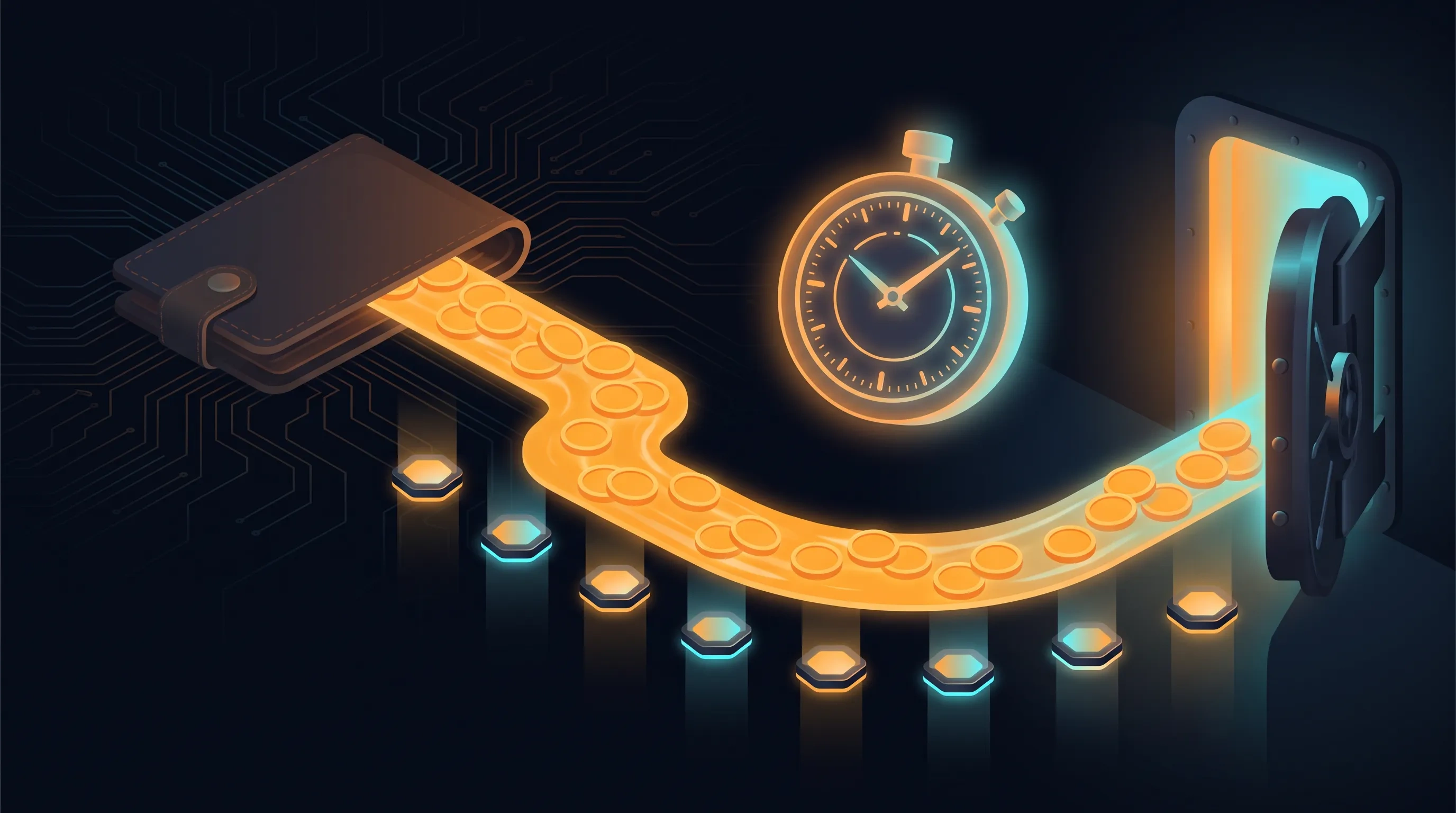
Short answer: Open the casino cashier, copy the exact Zcash deposit address it shows, and send ZEC from your own wallet to it. Check the address type first (t... or u...), send at least the listed minimum, and expect the credit after the operator's confirmation window - usually a few minutes for transparent sends.
Depositing Zcash to a casino is fast and cheap - most of the real risk is not the chain, it is sending the wrong kind of payment to the wrong kind of address. This walkthrough covers the whole route: reading the cashier page, picking the right address type, memos, confirmation windows, real fee numbers, and what to do when the credit does not arrive.
One thing changed in 2026 that every ZEC depositor should know before sending: the Ironwood upgrade sealed Zcash's old Orchard pool, so the pool your wallet spends from - and the one the operator's address points at - now matter more than they used to [7].
table of contents
Read the cashier page before you touch your wallet
The deposit page tells you three things you must not guess: the address, the minimum amount, and the address type. Zcash has three visibly different address families [4]:
- Transparent addresses start with
t1(ort3for multisig-style) and behave like Bitcoin: amounts, sender and receiver are public on-chain. - Shielded addresses start with
zs(Sapling) and carry encrypted amounts - and the only place a ZEC memo can live. - Unified addresses start with
uand bundle several receiver types into one encoding [4]. A unified address can include a transparent receiver.
That last point decides everything: a u... deposit address does not tell you whether the operator actually processes shielded payments. It only tells you the address format. If the cashier page does not say which receiver it uses, the pragmatic assumption for a deposit is: it works - operators watch their own deposit addresses. The subtlety matters on the way out (see our shielded vs transparent guide).
If the cashier offers a ZIP-321 payment URI (a zcash:... link with amount and memo pre-filled), use it - the standard exists exactly so wallets fill these fields automatically [1].
The deposit, step by step
- Open the casino's cashier and select Zcash (ZEC) - not a wrapped or bridged variant. If the operator offers ZEC on a non-Zcash network, that is a different asset with different risks; our review pages flag the difference where we found it.
- Copy the deposit address exactly. Wallets and casinos both warn about clipboard-hijacking malware for a reason - after pasting, verify the first and last six characters visually.
- Check the address type your wallet will send from and to. Sending to a
t...address from a shielded wallet is technically possible via the wallet's transparent path, but a shielded-to-shielded flow (or unified-to-unified) is what actually protects you [4]. - Send at least the listed minimum, from your own wallet. Exchange withdrawals work too, but they add KYC, batching and minimum-withdrawal rules of the exchange on top.
- Note your transaction ID immediately - it is your receipt if anything goes sideways.
- If the deposit flow shows a memo field, use exactly what the cashier displays. Memos exist only for shielded payments; a transparent deposit has no memo, and ZIP-321 explicitly makes a memo parameter on a transparent address invalid [1].
Confirmations: what is actually happening
Two different clocks run after your send, and confusing them causes most deposit panic:
- The operator's credit window. Casinos credit deposits after their own confirmation policy, and many do not publish it - ask support or test with a small amount first instead of assuming a fixed number. Shielded deposits additionally depend on when the operator's wallet scans the chain. Our review pages list each documented policy.
- Your own spendability clock. ZIP 315 recommends wallets treat received third-party ZEC as spendable only after 10 confirmations, and self-created notes after 3 - roughly twelve minutes at the 75-second target block spacing [2][9]. That number is wallet guidance, not a consensus rule: wallets implement their own policy and may configure it differently.
Neither clock is the "10-block unlock" folklore from other coins. A credit that shows up in four minutes and a spendable balance two minutes later are both normal.
Fees: what a ZEC deposit actually costs
Zcash fees are set by policy, not by auction. ZIP 317 prices a transaction at 5000 zatoshis (0.00005 ZEC) per logical action, with a grace of 2 actions - so an ordinary payment sits in the sub-cent range at any sane ZEC price [3]. Wallets implementing ZIP 317 charge that by default; some offer slow/standard/fast choices that differ by little.
Two fee facts worth knowing before a deposit:
- Zcash has no replace-by-fee. A too-low fee does not vanish; it confirms late or drops back to your wallet. Never "retry" a slow send by double-sending.
- Deposits themselves are usually free at the operator side - casinos that charge a deposit fee at all list it in the cashier. Our comparison table shows the documented ones.
When the deposit does not credit
Work this checklist in order - our payment help tool walks the same logic interactively:
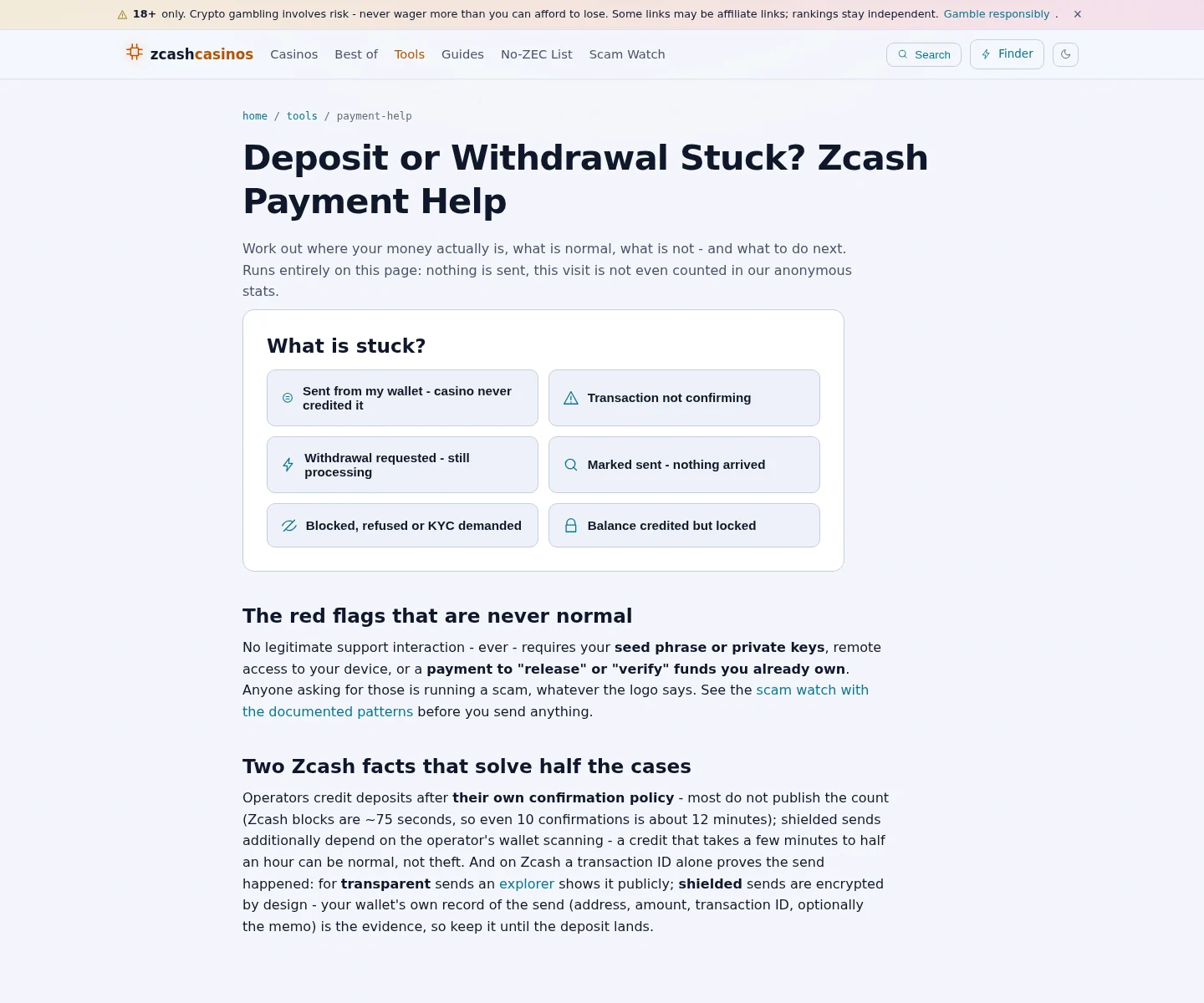
- Paste the transaction ID into an explorer (for transparent sends). Zero or few confirmations means wait - a low-fee send confirms late, it does not vanish. Zcash has no replace-by-fee; do not double-send.
- Compare against the minimum listed on the cashier page on the day you sent. Under-minimum sends are typically held until support maps them.
- Re-open the deposit page in the same account session and confirm the address you used is still the one shown. Session-scoped deposit addresses rotate on some sites.
- Only then contact support - with transaction ID, amount, date, and the deposit address. For transparent sends the explorer link is your proof. For shielded sends, your wallet's own record (address, amount, transaction ID, memo) is the evidence - keep it.
Over 24 hours uncredited is past every normal window: escalate in writing, and never pay a "release fee" or share your seed to "fix" a stuck deposit. Those are scam patterns, not support - our scam checklist lists them.
The TEX trap: "accepts ZEC" does not mean "accepts every ZEC payment path"
The single most documented Zcash deposit failure is not about casinos at all, but it explains the checklist: in 2024, Binance stopped crediting deposits sent from shielded addresses to its transparent deposit system, and affected users waited weeks [6]. The exchange said the deposits had to come from "readily identifiable" transparent sources.
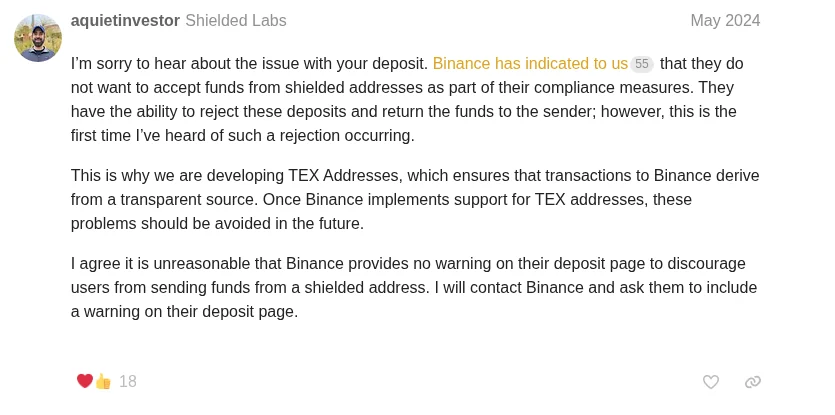
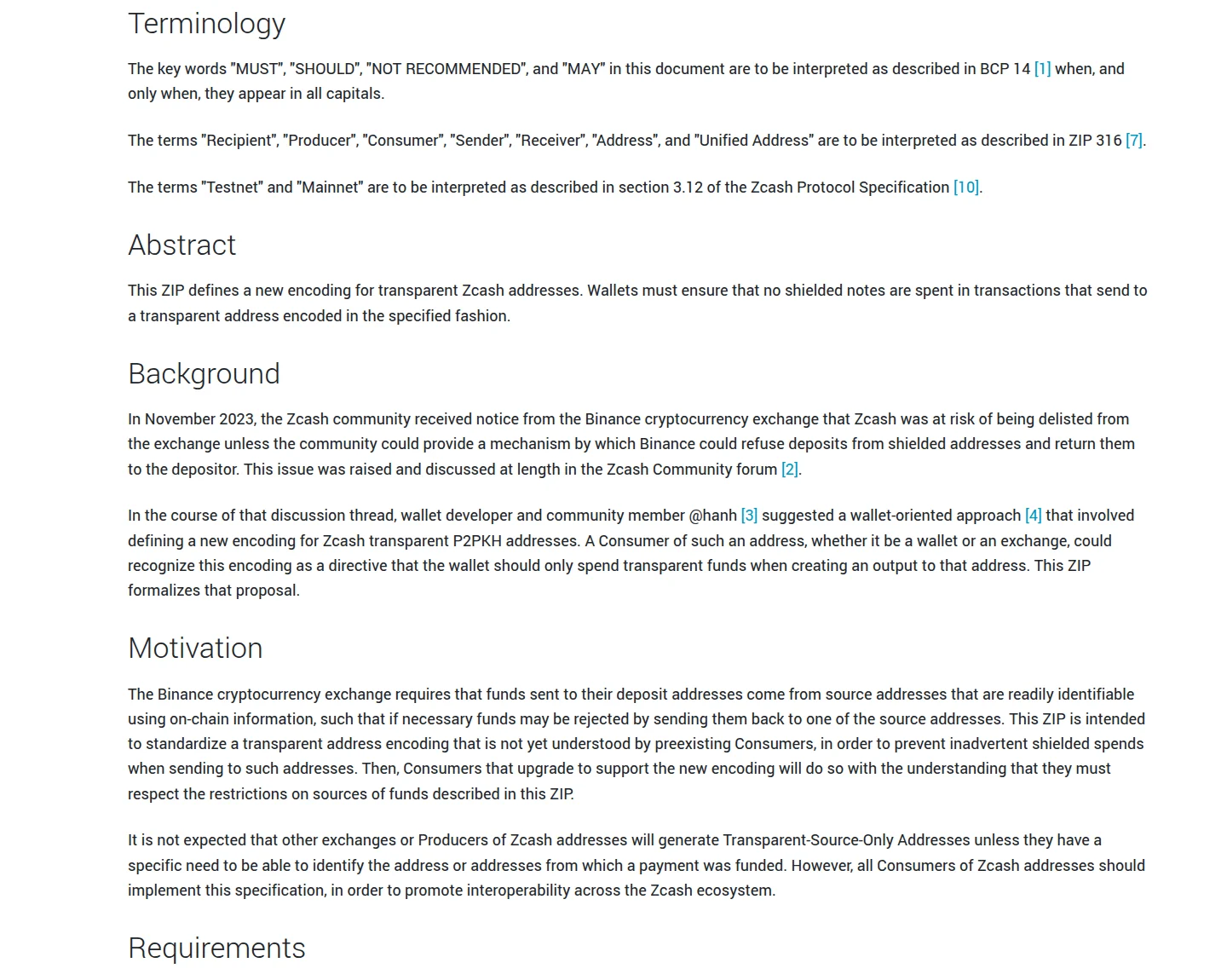
That demand became formalized as ZIP-320, the "Transparent Exchange Address" (TEX): a transparent address encoding that wallets must treat as a directive to spend no shielded notes into it [5]. The ZIP's own background names the November 2023 Binance delisting threat as the reason it exists.
The lesson transfers directly to casinos: an operator that demands transparent sources (or hands out TEX addresses) will document it somewhere - read the deposit page and the terms before funding, and keep your first deposit small enough to lose nothing but time. If the casino credits per-address and you deposit from a batched exchange withdrawal, the mapping can also confuse support - one more reason the no-KYC buying route starts from your own wallet.
Where to deposit right now
Operators with an active, operator-documented ZEC listing in our database - live values, no stale numbers (research candidates sit in the full table until their cashier is verified):
| Casino | KYC | VPN | Min deposit | Payout | Score | |
|---|---|---|---|---|---|---|
| Cloudbet | Risk-based KYC | VPN tolerated | 0.0003 ZEC | varies | 7.2 | Visit |
| Rakebit | unknown | VPN friendly | see review | varies | 4.4 | Visit |
| Bspin | unknown | unknown | see review | varies | 4 | Visit |
| DuckDice | Risk-based KYC | VPN tolerated | see review | varies | 6.2 | Visit (read warnings) |
| 1xBit | Selective KYC | VPN tolerated | see review | varies | 5.4 | Visit (read warnings) |
Live values from our database - details and caveats in each review. "Visit" links may be affiliated.
Ready to move money the other way? The withdrawal walkthrough covers payout addresses, the KYC trigger line, and how to verify what actually arrives.
FAQ
Do I need a memo when depositing ZEC?
Only if the casino's deposit page shows a memo field you are told to include. Memos only exist for shielded payments - a transparent (t...) deposit has no memo at all, and ZIP-321 makes a URI with a memo parameter on a transparent address invalid [1].
Why is my confirmed deposit not credited yet?
Operators credit after their own confirmation policy, and many do not publish it - ask support or test with a small amount first. A few minutes of delay are normal; over an hour past the stated window is a support case.
Can I deposit from an exchange instead of my own wallet?
You can if the exchange supports ZEC withdrawals, but you inherit its KYC and its withdrawal rules - and exchanges force transparent-rail deposits (see the TEX section below). A test deposit from your own shielded wallet first is the safer route.
What happens if I send less than the minimum deposit?
Many operators hold under-minimum deposits uncredited until support maps them manually. Send the listed minimum or more; if it already happened, open a ticket with the transaction ID and the exact amount.
My transaction has zero confirmations for over an hour - is the money gone?
No. Zcash has no replace-by-fee, so a low-fee send either confirms eventually or returns to your wallet. Do not send the same amount again to "retry" - the first send can still land.
Can the casino see my wallet balance after a deposit?
If you deposited to a transparent address, the deposit address history is public on-chain - that address, its amounts and its counterparties, not the rest of your wallet. A shielded deposit reveals none of that [4]. This is why the address type you send to decides the privacy of the whole route.
What address type should I send from?
From a shielded-first wallet you control (see the wallet guide). The receiving address type is the operator's choice; your sending wallet decides what your side of the transaction exposes.
Does the Ironwood upgrade change deposits?
It changed the pools. The old Orchard pool was sealed on 2026-07-28, so fresh deposits flow to the Ironwood or Sapling pools (or transparent) depending on the address the operator shows [7][8]. A wallet that is not Ironwood-ready can fail to see or spend newer shielded funds - check the wallet before you send.
Ready to pick a casino? The comparison table has the live values, the finder narrows them down:
Sources
- ZIP 321: Payment Request URIs - memo rule and URI format - accessed 2026-10-22
- ZIP 315: Best Practices for Wallet Implementations - 10/3 confirmation policy - accessed 2026-10-22
- ZIP 317: Recommended Transaction Fee Policy - 5000 zatoshi per logical action - accessed 2026-10-22
- ZIP 316: Unified Addresses - one address encoding bundling several receiver types - accessed 2026-10-22
- ZIP 320: Transparent Exchange Address (TEX) - background and requirements - accessed 2026-10-22
- Zcash forum: Binance rejecting deposits from Zcash shielded addresses (2024) - the deposit-route problem class, with the Shielded Labs TEX response - accessed 2026-10-22
- Zcash Foundation forum: Zebra, Zakura, and the road through NU6.3 (2026-07-16) - Ironwood activation and zcashd end of life - accessed 2026-10-22
- ZecHub wallet tracker - which wallets read which pools, Ironwood readiness - accessed 2026-10-22
- ZIP 208: Shorter Block Target Spacing - 75-second blocks after Blossom - accessed 2026-10-22
Further reading
- ZIP 321: Payment Request URIs - the zcash: link format that pre-fills address, amount and memo in your wallet
- ZIP 320: Transparent Exchange Address (TEX) - the standard behind transparent-only deposit addresses, worth a skim before you send
- ZIP 317: Recommended Transaction Fee Policy - how Zcash fees are actually calculated - usually cents, not the meme numbers
- ZecHub wallet tracker - pick a deposit wallet that reads the pools your casino route needs
- Zcash community forum - where stuck-deposit cases get read by wallet developers and operators