Zcash casinos with documented shielded payouts
Operators that document paying out to shielded or unified addresses - the difference between "accepts ZEC" and private payouts.
No casinos match this filter yet - check the full table.
The state of play: acceptance is common, private payouts are not
Every operator on this site accepts ZEC. Not one of them documents paying out to a shielded or unified address. That sentence is the whole market as of the last check, and it matters more than any ranking in the main table: a transparent withdrawal publishes the amount, the destination address and the casino's hot wallet on a public chain - a privacy downgrade most players never chose and rarely notice [1].
The distinction this page draws is the one the industry blurs: "accepts shielded deposits" and "pays out shielded" are different claims. Deposits you control - send from your own shielded balance. Payouts the operator controls - their wallet software, their address type, their choice. A casino that accepts your u1 address and sends your withdrawal to a t-address has given you a one-way door.
How a payout leaks, step by step

The leak is mechanical, not mysterious. When a casino processes your withdrawal it selects an address from your account record. If that record holds a unified address with a transparent receiver, the operator's wallet - allowed and even required by ZIP 316's receiver priority rules to use the receiver it supports - may send to the transparent component [2]. The result on-chain: amount, destination and the casino wallet, all public, all linkable.
Three failure modes cover nearly every case:
- Transparent payout of a shielded deposit. The operator de-shields internally, sends to a t-address. Amount and destination are public; the timing links the withdrawal to your deposit.
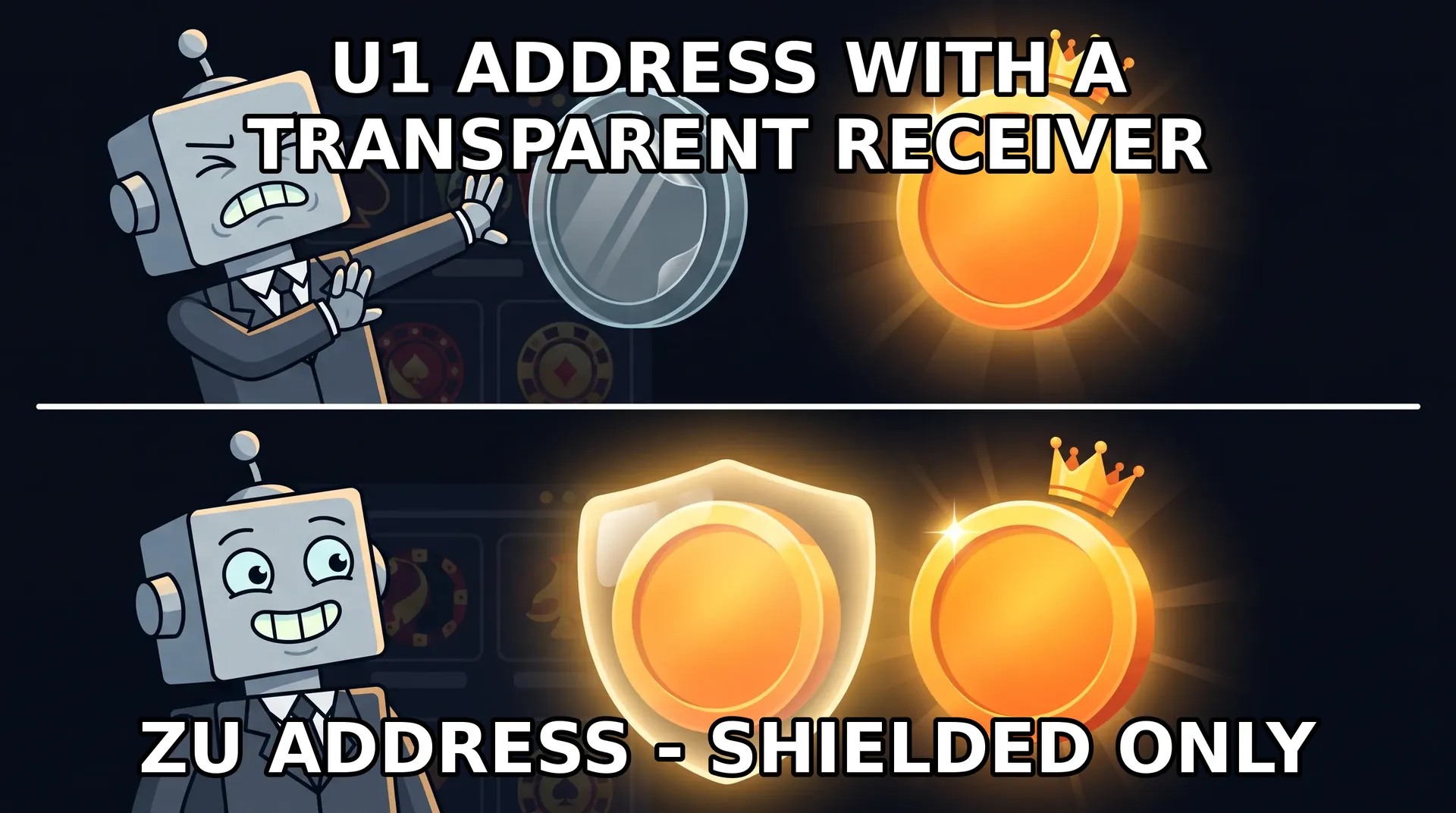
- Unified address with transparent receiver. Looks private, pays public. ZIP 316 revision 2 introduced the
zuprefix (shielded-only) because users could not visually distinguish addresses that leak from those that do not [2]. - Same hot wallet for everyone. Even shielded-looking payouts can cluster: many players paid from one transparent wallet in matching amounts is a pattern any analyst can read.
What the chain shows right now
The honest baseline: about 4.89 million ZEC - 28.8% of issued supply - sits in shielded pools today, against roughly 12.0 million ZEC in the transparent pool [1]. Daily boundary flows run in the tens of thousands of ZEC in both directions [1]. A casino payout that de-shields is one of the most identifiable shapes in that flow: larger, regular, destination-linked.

The pool layout matters for your wallet hygiene: Orchard sealed when Ironwood activated on July 28, 2026, and Orchard funds now exit only through the turnstile into Ironwood [4]. Modern wallets migrated automatically; a casino that still pays out via old Sapling or transparent-only infrastructure is telling on itself.
How to get a (mostly) private payout today
Nobody on this page documents a shielded path, so the practical playbook is minimization:
- Use a zu-prefixed or z-only receiving address where the operator supports it - it removes the transparent fallback from the negotiation entirely [2].
- Ask support the specific question before you deposit big: "Do you send withdrawals to shielded addresses?" The phrasing of the answer - technical vs. boilerplate - is signal.
- Test with the minimum. Watch the transaction on an explorer. One withdrawal tells you the operator's actual path; five hundred words of marketing tell you nothing.
- Withdraw promptly and in irregular amounts. If the payout lands transparent anyway, you at least shorten the window and break the round-number pattern.
- Never recycle the receiving address across operators. Address reuse welds your accounts together even when individual payouts look clean.
What would move an operator into this page's list
We list an operator here only when its payout path to shielded or unified addresses is documented - operator page text, support quote or wallet-level evidence, with a date. The evidence bar is deliberately narrow because "we support ZEC privacy" marketing has repeatedly failed a support-ticket test. When any tracked operator passes, this hub flips from a state-of-the-market page into a ranking; the [0] counter above updates automatically.
Until then, treat every ZEC payout as public by default: fund from a wallet you control (wallet guide), verify any roll you bet on (provably fair), and size deposits to the operator's payout record - the scam watch list tracks which operators have already failed one [3].
Sources
- ZecStats - Zcash shielded pools, live balances and boundary flows - accessed 2026-09-30
- Zcash ZIP 316 - Unified Addresses (zu/tu revisions, receiver priority) - accessed 2026-09-30
- Zcash ZIP 315 - wallet best practices (10-confirmation untrusted policy) - accessed 2026-09-30
- z.cash - NU6.3 Ironwood activation and Orchard turnstile - accessed 2026-09-30
- DuckDice Zcash casino page (archived capture) - accessed 2026-09-30
// FAQ
Does a unified address (u1...) guarantee a private payout?
No. A unified address can contain a transparent receiver, and the sender's wallet picks the receiver it supports. Revision 2 introduced the zu prefix for shielded-only addresses precisely because u1 alone never proved privacy - check which receivers the address contains before trusting it.
Do any tracked casinos pay out to z-addresses?
None of the eleven operators we track document a shielded payout path as of the last check. Several market Zcash privacy in their copy while documenting nothing about their withdrawal address types - that gap is the finding, not an oversight.
How do I test what a casino actually sends?
Make a small withdrawal to a unified address whose transparent receiver you can watch, then look up the transaction on a block explorer. A public t-amount with a t-destination means the operator de-shielded before paying - whatever the marketing says.
Can I deposit shielded if the casino pays out transparent?
Technically yes, but you buy little: your deposit hides, then the payout re-identifies the account and, by timing and amounts, the same wallet. A one-way shielded deposit is a half-open curtain.
What is the Orchard-to-Ironwood turnstile?
NU6.3 (July 28, 2026) sealed the Orchard pool - new shielded activity lands in the Ironwood pool, and Orchard funds exit only through the turnstile into Ironwood. Wallets handle the migration; balances stay private during it.
Why is the shielded share of supply relevant to me?
Your anonymity set is everyone else in the pool. At roughly 28.8% of supply in shielded pools, an individual transaction blends into millions of ZEC - but only if the casino's payout path does not drop your identity back on the public ledger.