18+ only. Crypto gambling involves risk - never wager more than you can afford to lose. Some links may be affiliate links; rankings stay independent. Gamble responsibly.
Lists Zcash in its official coin list - but the 1xBet-network track record (confiscation patterns, Byline Times reporting) keeps it off any recommendation list. Test with tiny amounts only.
Selective KYCZEC listed
Up to 7 BTC across 4 depositsHigh rollover, strict terms
Poker is a different bet - the house is not in the hand
Every other hub on this site is about games where you play against the operator's edge. Poker inverts it: players compete for each other's money, and the operator collects rent. That rent is the rake - typically 2.5-10% of each pot, capped, and 5-10% tournament fees - and it is the only number on the page the operator truly controls [1].
The consequence for ZEC players: ranking a poker room by "house edge" is a category error. The things to compare are rake schedule, cap structure, liquidity and operator trust - and the tracked set gives you exactly one ZEC-reachable room, which makes this page more about what to check than what to pick.
The rake, decomposed
Rake vs cap: why micro-stakes players pay the highest effective percentage - and where tournament fees stack
Three numbers define a room's cost structure:
Percentage: 2.5-10% of the pot is the industry band [1]. Below ~3% is competitive; above 5% is a tax on playing.
Cap: the maximum taken per pot, usually expressed in big blinds. Caps are why the effective rake at micro stakes can exceed the nominal percentage - a 0.01 ZEC pot paying a 0.001 cap is 10%.
No-flop-no-drop: whether the room takes rake on hands that end preflop. Rooms that do not charge on uncalled bets refund it; rooms that do are quietly 1-2% more expensive.
Tournament fees are separate and worse: a 10% fee on every buy-in is the price of admission, paid whether you cash or not [1].
The trust layer: what actually goes wrong
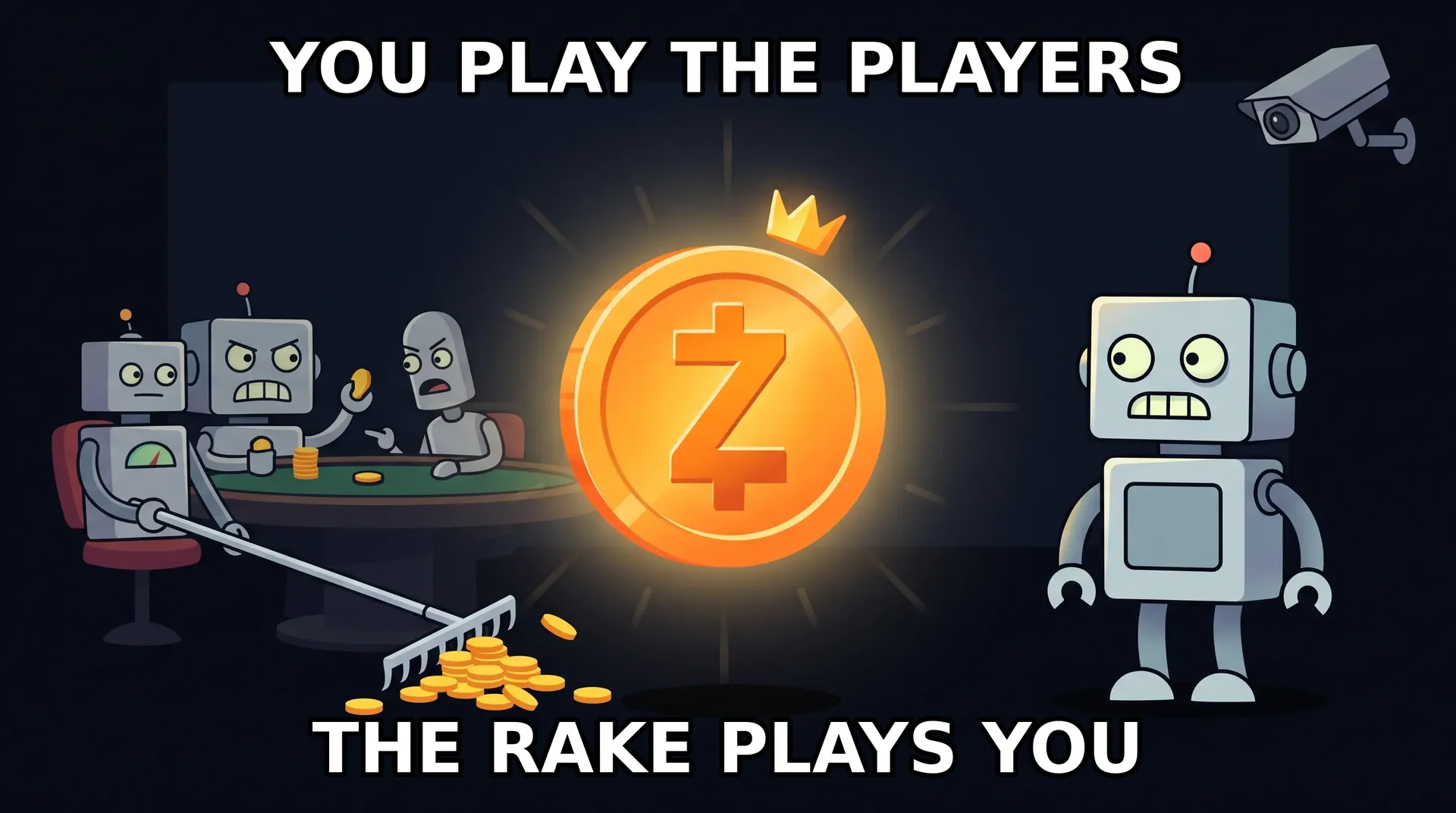
A house robot sweeps the pot with a rake while two players stare at a hand history looking for the superuser account.
Poker's failure modes are operator-side, not mathematical:
Superuser accounts - the historical scandal class of online poker. An operator with server-side hole-card access can lose on purpose. This is why operator identity and track record weigh more in this hub than anywhere else; the scam checklist applies with full force.
Bot rings and collusion. Operators fight these with hand-history analysis and device fingerprinting [2] - which is a privacy trade: the room needs more of your behavioral data than a dice site ever will. A poker account is a KYC-adjacent data object even when no ID was collected.
Withdrawal reliability. Poker bankrolls are larger and stickier than dice balances. The payout path question (shielded hub) and the withdrawal speed record matter more here per unit deposited.
Where ZEC fits a poker bankroll
Poker is the game where ZEC's rails matter least and bankroll discipline matters most:
Deposits settle fast. Native ZEC credits in ~75-second blocks; spendable in your wallet after ~10 confirmations per ZIP 315 defaults [3]. Operators on token rails make you wait 10-30 minutes for the same deposit.
Fee math favors larger, rarer movements. Network fees are per-transaction, and a poker bankroll moves in chunks, not spins - the ZEC fee schedule (ZIP 317's ~0.0001 conventional fee) is a rounding error at stakes that matter.
Session tracking is real work. Rake makes poker a long-horizon game; a journal that tracks deposits, sessions and withdrawals in piconero-precise ZEC units is the difference between "roughly break-even" and knowing your actual win rate.
The honest state of the lane
The population on this page is 1 operator, and its review carries red flags worth reading before any deposit. There is no ZEC-native poker alternative - the market that produced ZEC-native dice sites never produced a poker room, because table liquidity and anti-collusion infrastructure are a different order of investment. Until one appears, the practical choices are: the one tracked room (eyes open, minimum deposits), or RNG poker variants at casinos that verify fairness - which is a different game wearing the same name.
In our tracked set, exactly one - 1xBit runs a poker lobby and lists ZEC. No ZEC-native poker room exists today; the dedicated crypto poker sites that once served this niche run on BTC and major altcoins. The honest options are one multipurpose lobby or RNG poker variants at casinos.
How much does the rake actually cost?
Live and online rooms typically take 2.5-10% of the pot, capped at a few big blinds; tournament fees run 5-10% of the buy-in. At micro stakes the cap dominates and the effective rate can exceed 10%. Over a session, rake is the biggest cost in poker by far - bigger than any bad beat.
Is online poker with ZEC fair against other players?
You are not playing against the house, so "provably fair" is the wrong frame - the operator deals cards and must not see hole cards. The real risks are bot rings, collusion and superuser accounts. Hand-history analysis and device fingerprinting are the operator's defenses; your defense is choosing an operator with a reputation to lose.
Does ZEC change poker strategy?
Not the cards - the rails. Deposits and withdrawals settle in ~75-second blocks, so bankroll top-ups are fast, and if the operator's payout path is shielded, your bankroll movements stay private. Table play is identical to any other currency.
Why is there no ZEC-native poker room?
Poker needs liquid tables and anti-collusion tooling - expensive infrastructure for a coin with a small gambling footprint. Dice and slots work at any scale; poker does not. The RAND darknet research found ZEC under 1% of crypto mentions, and the gambling vertical mirrors that.
Are video-poker style games the same as poker?
No. Video poker and casino hold'em are RNG games against the house with a fixed paytable - closer cousins of slots than of poker. The edge is set by the paytable, not by other players' mistakes.